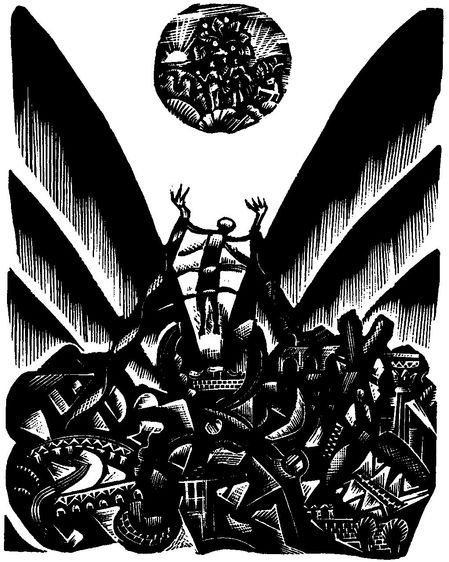
Beyond Civilization
Technical civilization is the product of labor, of man’s exertion of power for the sake of gain, for the sake of producing goods. It begins when man, dissatisfied with what is available in nature, becomes engaged in a struggle with the forces of nature in order to enhance his safety and to increase his comfort. To use the language of the Bible, the task of civilization is to subdue the earth, to have dominion over the beast.
How proud we often are of our victories in the war with nature, proud of the multitude of instruments we have succeeded in inventing, of the abundance of commodities we have been able to produce. Yet our victories have come to resemble defeats. In spite of our triumphs, we have fallen victims to the work of our hands; it is as if the forces we had conquered have conquered us.
Is our civilization a way to disaster, as many of us are prone to believe? Is civilization essentially evil, to be rejected and condemned? The faith of the Jew is not a way out of this world, but a way of being within and above this world; not to reject but to surpass civilization. The Sabbath is the day on which we learn the art of surpassing civilization.
Adam was placed in the Garden of Eden “to dress it and to keep it” (Genesis 2:15). Labor is not only the destiny of man; it is endowed with divine dignity. However, after he ate of the tree of knowledge he was condemned to toil, not only to labor “In toil shall thou eat … all the days of thy life” (Genesis 3:17). Labor is a blessing, toil is the misery of man.
The Sabbath as a day of abstaining from work is not a depreciation but an affirmation of labor, a divine exaltation of its dignity. Thou shalt abstain from labor on the seventh day is a sequel to the command: Six days shalt thou labor, and do all thy work.1
“Six days shalt thou labor and do all thy work; but the seventh day is Sabbath unto the Lord thy God.” Just as we are commanded to keep the Sabbath, we are commanded to labor.2 “Love work …”3 The duty to work for six days is just as much a part of God’s covenant with man as the duty to abstain from work on the seventh day.4
To set apart one day a week for freedom, a day on which we would not use the instruments which have been so easily turned into weapons of destruction, a day for being with ourselves, a day of detachment from the vulgar, of independence of external obligations, a day on which we stop worshipping the idols of technical civilization, a day on which we use no money, a day of armistice in the economic struggle with our fellow men and the forces of nature—is there any institution that holds out a greater hope for man’s progress than the Sabbath?
The solution of mankind’s most vexing problem will not be found in renouncing technical civilization, but in attaining some degree of independence of it.
In regard to external gifts, to outward possessions, there is only one proper attitude—to have them and to be able to do without them. On the Sabbath we live, as it were, independent of technical civilization: we abstain primarily from any activity that aims at remaking or reshaping the things of space. Man’s royal privilege to conquer nature is suspended on the seventh day.
What are the kinds of labor not to be done on the Sabbath? They are, according to the ancient rabbis, all those acts which were necessary for the construction and furnishing of the Sanctuary in the desert.5 The Sabbath itself is a sanctuary which we build, a sanctuary in time.
It is one thing to race or be driven by the vicissitudes that menace life, and another thing to stand still and to embrace the presence of an eternal moment.
The seventh day is the armistice in man’s cruel struggle for existence, a truce in all conflicts, personal and social, peace between man and man, man and nature, peace within man; a day on which handling money is considered a desecration, on which man avows his independence of that which is the world’s chief idol. The seventh day is the exodus from tension, the liberation of man from his own muddiness, the installation of man as a sovereign in the world of time.
In the tempestuous ocean of time and toil there are islands of stillness where man may enter a harbor and reclaim his dignity. The island is the seventh day, the Sabbath, a day of detachment from things, instruments and practical affairs as well as of attachment to the spirit.
The Sabbath must all be spent “in charm, grace, peace, and great love … for on it even the wicked in hell find peace.” It is, therefore, a double sin to show anger on the Sabbath. “Ye shall kindle no fire throughout your habitations on the Sabbath day” (Exodus 35:3), is interpreted to mean: “Ye shall kindle no fire of controversy nor the heat of anger.” 6 Ye shall kindle no fire—not even the fire of righteous indignation.
Out of the days through which we fight and from whose ugliness we ache, we look to the Sabbath as our homeland, as our source and destination. It is a day in which we abandon our plebeian pursuits and reclaim our authentic state, in which we may partake of a blessedness in which we are what we are, regardless of whether we are learned or not, of whether our career is a success or a failure; it is a day of independence of social conditions.
All week we may ponder and worry whether we are rich or poor, whether we succeed or fail in our occupations; whether we accomplish or fall short of reaching our goals. But who could feel distressed when gazing at spectral glimpses of eternity, except to feel startled at the vanity of being so distressed?
The Sabbath is no time for personal anxiety or care, for any activity that might dampen the spirit of joy. The Sabbath is no time to remember sins, to confess, to repent or even to pray for relief or anything we might need. It is a day for praise, not a day for petitions. Fasting, mourning, demonstrations of grief are forbidden. The period of mourning is interrupted by the Sabbath. And if one visits the sick on the Sabbath, one should say: “It is the Sabbath, one must not complain; you will soon be cured.”7 One must abstain from toil and strain on the seventh day, even from strain in the service of God.8
Why are the Eighteen Benedictions not recited on the Sabbath? It is because the Sabbath was given to us by God for joy, for delight, for rest, and should not be marred by worry or grief. Should there be a sick one in the household, we might remember this while reciting the benediction: “Heal the sick,” and would become saddened and gloomy on the Sabbath day. It is for this same reason that we recite in the Sabbath grace after meals the request that “there be no sadness or trouble in the day of our rest.”9 It is a sin to be sad on the Sabbath day.10
For the Sabbath is a day of harmony and peace, peace between man and man, peace within man, and peace with all things. On the seventh day man has no right to tamper with God’s world, to change the state of physical things. It is a day of rest for man and animal alike:
In it thou shalt not do any manner of work, thou nor thy son, nor thy daughter, nor thy man-servant, nor thy maid-servant, nor thine ox, nor thine ass, nor any of thy cattle, nor thy stranger that is within thy gates; that thy man-servant and thy maid-servant may rest as well as thou.11
Rabbi Solomon of Radomsk once arrived in a certain town, where, he was told, lived an old woman who had known the famous Rabbi Elimelech. She was too old to go out, so he went to see her and asked her to tell him what she knew about the great Master.
—I do not know what went on in his room, because I worked as one of the maids in the kitchen of his house. Only one thing I can tell you. During the week the maids would often quarrel with one another, as is common. But, week after week, on Friday when the Sabbath was about to arrive, the spirit in the kitchen was like the spirit on the eve of the Day of Atonement. Everybody would be overcome with an urge to ask forgiveness of each other. We were all seized by a feeling of affection and inner peace. 12
The Sabbath, thus, is more than an armistice, more than an interlude; it is a profound conscious harmony of man and the world, a sympathy for all things and a participation in the spirit that unites what is below and what is above. All that is divine in the world is brought into union with God. This is Sabbath, and the true happiness of the universe.
“Six days shalt thou labor and do all thy work (Exodus 20:8). Is it possible for a human being to do all his work in six days? Does not our work always remain incomplete? What the verse means to convey is: Rest on the Sabbath as if all your work were done. Another interpretation: Rest even from the thought of labor.” 13
A pious man once took a stroll in his vineyard on the Sabbath. He saw a breach in the fence, and then determined to mend it when the Sabbath would be over. At the expiration of the Sabbath he decided: since the thought of repairing the fence occurred to me on the Sabbath I shall never repair it.14