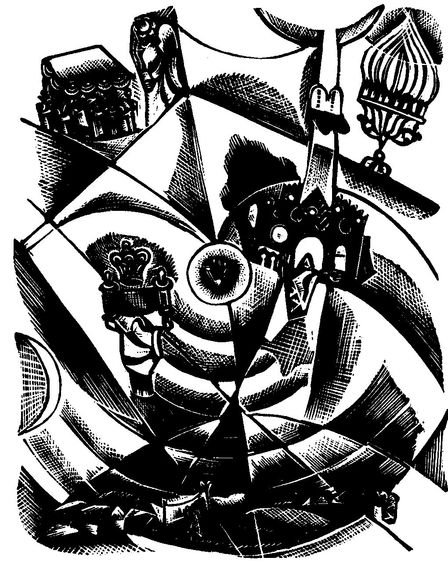
“Thou Art One”
An allegory.
At the beginning time was one, eternal. But time undivided, time eternal, would be unrelated to the world of space. So time was divided into seven days and entered into an intimate relationship with the world of space. With every single day, another realm of things came into being, except on the seventh day. The Sabbath was a lonely day. It may be compared to a king who has seven sons. To six of them he gave his wealth, and the youngest one he endowed with nobility, with the prerogative of royalty. The six older sons who were commoners found their mates, but the noble one remained without a mate.
Says Rabbi Shimeon ben Yohai:
After the work of creation was completed, the Seventh Day pleaded: Master of the universe, all that Thou hast created is in couples; to every day of the week Thou gavest a mate; only I was left alone. And God answered: The Community of Israel will be your mate.
That promise was not forgotten. “When the people of Israel stood before the mountain of Sinai, the Lord said to them: ‘Remember that I said to the Sabbath: The Community of Israel is your mate.’ Hence: Remember the Sabbath day to sanctify it” (Exodus 20:8). The Hebrew word le-kadesh, to sanctify, means, in the language of the Talmud, to consecrate a woman, to betroth. Thus the meaning of that word on Sinai was to impress upon Israel the fact that their destiny is to be the groom of the sacred day, the commandment to espouse the seventh day.1
With all its grandeur, the Sabbath is not sufficient unto itself. Its spiritual reality calls for companionship of man. There is a great longing in the world. The six days stand in need of space; the seventh day stands in need of man. It is not good that the spirit should be alone, so Israel was destined to be a helpmeet for the Sabbath.
To understand the significance of that new conception, it is important to be aware of the mood of the age. Rabbi Shimeon belonged to a generation which, under the leadership of Bar Kochba, rose in arms against the might of Rome in a last effort to regain independence and to rebuild the Temple in Jerusalem. Israel without the sanctuary seemed alone in the world. The revolt was crushed; it became clear that there was no possibility of another uprising. The sanctuary in space was going to remain in ruins for many a long day. But Rabbi Shimeon’s idea proclaimed Israel was not alone. Israel is engaged to holiness, to eternity. The match was made long before history began; the Sabbath was a union that no one could disjoin. What God put together could not be set apart.
At a time when, in Rome, the deification of the Emperor was an official doctrine, Rabbi Shimeon extolled the most abstract of things: time, the seventh day. Jewish tradition had an aversion to personification, yet in their allegories it rhetorically personified the wisdom of the Torah. The boldness of Rabbi Shimeon was in extolling a day and in proclaiming the intimate union of Israel and the Sabbath.
Rabbi Shimeon’s concept alludes to the idea that man’s relation to the spirit is not one-sided; there is a reciprocity between man and the spirit. The Sabbath is not only a legal institution, a state of mind or a form of conduct, but a process in the world of spirit. At the beginning of time there was a longing, the longing of the Sabbath for man.
Through Rabbi Shimeon ben Yohai, the light of a great idea was caught in the mirror of a word, one that conveys the destiny of a people and the nimbus of a day. It did not remain a theory; it was an insight that made history. Ingrained in the soul of the people, it found expression throughout the ages in their thoughts, songs and customs.
Only two generations had gone by since the time of Rabbi Shimeon and there was a new tone in the celebration of the day. About the middle of the third century, distinguished scholars speak of the seventh day not as if referring to abstract time, elusive and constantly passing us by. The day was a living presence, and when it arrived they felt as if a guest had come to see them. And, surely, a guest who comes to pay a call in friendship or respect must be given a welcome. It is, indeed, told of Rabbi Yannai that his custom was to don his robes on the eve of the Sabbath, and then address himself to the ethereal guest: “Come O Bride, Come O Bride.” 2 Of another contemporary, Rabbi Hanina the Great, we know that at the sunset of Sabbath eve, he would clothe himself in beautiful robes, burst forth in a dance3 and exclaim, presumably in the presence of his friends: “Come, let us go out to welcome the Queen Sabbath.”4
There are two aspects to the Sabbath, as there are two aspects to the world. The Sabbath is meaningful to man and is meaningful to God. It stands in a relation to both, and is a sign of the covenant entered into by both. What is the sign? God has sanctified the day, and man must again and again sanctify the day, illumine the day with the light of his soul. The Sabbath is holy by the grace of God, and is still in need of all the holiness which man may lend to it.
The Sabbath is meaningful to God, for without it there would be no holiness in our world of time. In discussing the meaning of the verse, “and on the seventh day He finished His work,”5 the ancient rabbis suggested that an act of creation took place on the seventh day. The world would not be complete if the six days did not culminate in the Sabbath. Geniba and the rabbis discussed this.6 Geniba said: This may be compared to a king who made a bridal chamber, which he plastered, painted and adorned; now what did the bridal chamber lack? A bride to enter it. Similarly, what did the universe still lack? The Sabbath. The rabbis said: Imagine a king who made a ring: What did it lack? A signet. Similarly, what did the universe lack? The Sabbath.7
The Sabbath is a bride, and its celebration is like a wedding.
“We learn in the Midrash that the Sabbath is like unto a bride. Just as a bride when she comes to her groom is lovely, bedecked and perfumed, so the Sabbath comes to Israel lovely and perfumed, as it is written: And on the Seventh Day He ceased from work and He rested (Exodus 31:17), and immediately afterwards we read: And He gave unto Moses kekalloto [the word kekalloto means when he finished, but it may also mean] as his bride,8 to teach us that just as a bride is lovely and bedecked, so is the Sabbath lovely and bedecked; just as a groom is dressed in his finest garments, so is a man on the Sabbath day dressed in his finest garments; just as a man rejoices all the days of the wedding feast, so does man rejoice on the Sabbath; just as the groom does no work on his wedding day, so does a man abstain from work on the Sabbath day; and therefore the Sages and ancient Saints called the Sabbath a bride.
“There is a hint of this in the Sabbath prayers. In the Friday evening service we say Thou hast sanctified the seventh day, referring to the marriage of the bride to the groom (sanctification is the Hebrew word for marriage). In the morning prayer we say: Moses rejoiced in the gift [of the Sabbath] bestowed upon him which corresponds to the groom’s rejoicing with the bride. In the additional prayer we make mention of the two lambs, the fine flour for a meal offering, mingled with oil and the drink thereof referring to the meat, the bread, the wine, and the oil used in the wedding banquet. [In the last hour of the day we say] Thou art One to parallel the consummation of the marriage by which the bride and groom are united.” 9